Growing and Maintaining NAMA Student Chapters
For Erin Jarolimek, being a member of a student NAMA chapter definitely helped her get a job after graduating from North Dakota State University in Fargo, N.D. She graduated in May, 2003.
“I use the skills I learned as a NAMA member every day in my career,†Jarolimek says. “Being a member provided me with good foundation skills and the networking opportunities made me more confident that I could do well in the job market.â€
Membership in a NAMA student chapter allows students to network with professionals and develops skills in marketing, communication, leadership and team-building. As the name implies, the organization is focused on marketing.
NAMA has approximately 3,500 student members globally, and includes 38 U.S. and Canadian chapters.
Despite the benefits, offering and participating in NAMA can be challenging and requires considerable resources, says Cheryl Wachenheim, NDSU Department of Agribusiness and Applied Economics associate professor. To develop recommendations to help NAMA chapters grow and thrive, Wachenheim surveyed NAMA chapter advisers.
“My goal was to develop recommendations to help student chapters maintain and grow their viability as co-curricular activities,†Wachenheim says.
From the survey, Wachenheim was able to develop plans for advisors and universities to boost student NAMA memberships. She also developed a series of recommendations for professionals in the agri-marketing industry.
* Get to know the students in NAMA and make approaching you easy for them.
* Help faculty recruit students and encourage/entice them to be active in the student and professional NAMA chapters. Let students know you care they are participating and that you and your firm value their efforts and experiences.
* Help the students finance their activities because the activities, such as attending the national conference, can be an insurmountable expense for many students.
* Contact the dean of the supporting college or the chairman of a department. This can do wonders for gaining internal support for the student chapter. Write the president of the college explaining how important a student NAMA chapter is to you, your firm, community, profession, university and the students.
* Make sure your firm knows the benefits of your participation with a NAMA student chapter. Receiving recognition for your interaction with the chapter will help sustain it over the longer term.
“Becoming involved as a professional can take time out of our busy schedules, but seeing the students mature and develop skills is very rewarding,†Jarolimek says. “As professionals in the agri-marketing industry, we want to hire the best and brightest students out of college. Hiring students that were active NAMA members will give us these types of students.â€
To learn more about student NAMA chapters and find the one closest to your community, visit www.nama.org/student/student-index.html.
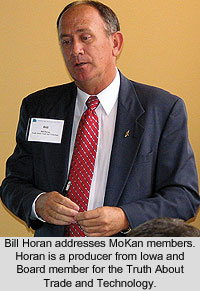 Thirty-six members and guests of the MoKan NAMA Chapter met at Union Station on Nov. 14, prior to the kick-off of the NAMA Agribusiness Forum in Kansas City.Â
Thirty-six members and guests of the MoKan NAMA Chapter met at Union Station on Nov. 14, prior to the kick-off of the NAMA Agribusiness Forum in Kansas City. 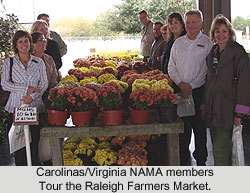 Often our jobs take us away from home, perhaps out of the state and maybe even out of the country to promote agriculture in a variety of ways. Carolinas/Virginia members and guests learned what the North Carolina Department of Agriculture and Consumer Services is doing to promote the state’s leading industry, agriculture.
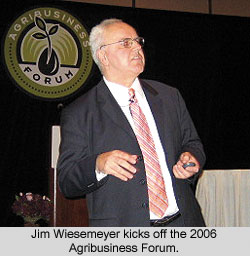 Noted economist and Washington observer, Jim Wiesemeyer, kicked off the 2006 Agribusiness Forum, November 14-15, in Kansas City. Wiesemeyer and Forum attendees looked at the Global Forces Shaping Agriculture.
 Agriculture is going through a dramatic change. Don Wick, Red River Farm Network, led a panel discussion on Tuesday, November 14, on how large producers are helping the agriculture industry keep up with these changes and how they are becoming a driving influence for suppliers. Panel members included John Vrieze and Tyler Bruch. Wick has been in farm broadcasting for 25 years and is a two-time winner of the “Oscars in Agriculture” for excellence in agricultural journalism. Wick is also a past president of the National Association of Farm Broadcasting and is a columnist for DairyStar.
 John Vrieze is in partnership with Emerald and Baldwin Dairys in Wisconsin; he also serves on the board of the Russian Farm Community Project that operates a 500-cow dairy 60 miles north of Moscow. Vrieze is a third-generation dairy producer who in 1990 went into Russia to explore the options and in 2001 built the 500-cow dairy. His operation is one of the highest milk producers in Russia. He is currently building a 3,200-cow dairy facility on 9,000 acres of land in southern Siberia.
 Tyler Bruch left his family farm in Emmetsburg, Iowa, after graduating from Iowa State University four years ago to start a farming operation in Bahia, Brazil. Bruch currently farms about 11,000 acres of soybeans, cotton and popcorn. Bruch is the owner and CEO of Global Ag Investments, a U.S. based private equity fund that allows U.S. investors to invest into U.S. managed agriculture in Brazil. He is also a partner in Global Ag Bio Diesel which is a 15 million gallon plant under formation that is due to break ground in February 2007. This plant will use cotton and soybean seed for bio diesel and will be sold to the local market. Bruch is also a silent partner with his brother and parents on their farm in Emmetsburg, Iowa. There they farm about 3,500 acres.